Insurance can feel like a confusing world of jargon — premiums, deductibles, underwriting, riders. But at its core, insurance is a fairly simple idea. This guide breaks it down so you understand exactly what you’re paying for and how the system works behind the scenes.
The Basic Idea: Pooling Risk
Insurance exists to solve one problem: bad things happen, and they’re expensive when they do. A car accident, a house fire, a medical emergency — any of these can cost far more than most people have saved.
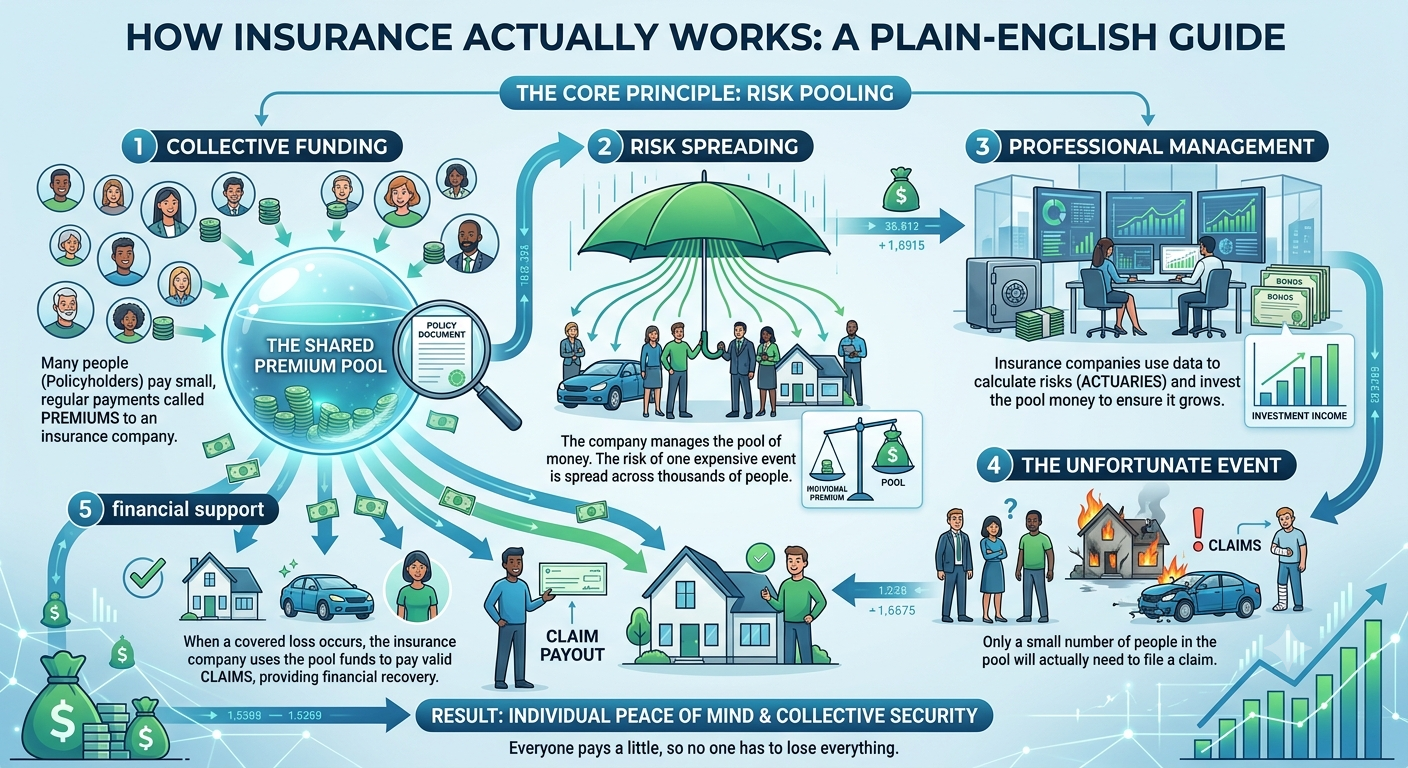
Insurance works by pooling risk across a large group of people. Everyone pays a relatively small amount (a premium) into a shared pool. Most people won’t need to make a claim in any given year, but the ones who do get paid out from that shared pool. The insurance company manages the pool, predicts how much money will be needed, and prices premiums so the pool stays solvent — with a profit margin built in.
Insurance operates on the principle of shared risk: many people pay a predictable, regular fee—called a premium—into a common financial pool so that no single individual faces financial ruin when an unexpected disaster strikes. Actuaries calculate the statistical likelihood of accidents, illnesses, or property damage within a large population, enabling insurance companies to price premiums high enough to cover claims while earning a return by investing the unspent funds in stable assets. When an unforeseen event occurs, policyholders pay an agreed-upon out-of-pocket amount, known as a deductible, after which the insurer steps in to cover the remaining costs up to the policy limit. Ultimately, insurance turns catastrophic, unpredictable risks into manageable, fixed expenses.
Key Terms You’ll Actually Use
- Premium — the amount you pay (monthly, quarterly, or annually) to keep your coverage active.
- Deductible — the amount you pay out of pocket before your insurance starts covering a claim. A higher deductible usually means a lower premium, and vice versa.
- Coverage limit — the maximum amount the insurer will pay out for a covered claim.
- Premium vs. payout trade-off — insurers price premiums based on the statistical likelihood and cost of you filing a claim. This is why a 20-year-old driver pays more for auto insurance than a 45-year-old with a clean record: statistically, younger drivers file more claims.
- Underwriting — the process insurers use to assess your risk level (age, health, driving history, location, etc.) and decide how much to charge you, or whether to offer coverage at all.
- Policy — the actual contract that spells out what’s covered, what’s excluded, and under what conditions you’ll get paid.
How a Claim Actually Works
- Something happens — an accident, illness, theft, fire, etc.
- You file a claim — you report the incident to your insurer with relevant documentation (photos, police reports, medical records, receipts).
- The insurer investigates — an adjuster reviews the claim to confirm it’s covered under your policy and estimates the cost.
- You pay your deductible — if applicable, this is subtracted from the payout or paid by you directly.
- The insurer pays out — either directly to you, or to a third party (a repair shop, a hospital, a contractor) depending on the type of policy.
Why Premiums Differ So Much Between People
Two people can have the exact same policy type and pay wildly different premiums. That’s because insurers use dozens of variables to estimate your personal risk level, such as:
- Age and driving/claims history (auto insurance)
- Health history and lifestyle habits like smoking (life and health insurance)
- Location — crime rates, weather risk, and local repair costs all matter (home and auto insurance)
- Credit-based insurance scores (used in many states for auto and home insurance)
- Type of coverage and limits chosen
This is also why shopping around matters so much — different insurers weigh these factors differently, so the same person can get very different quotes from different companies.
The Main Types of Insurance, in One Line Each
- Auto insurance — covers damage or liability from car accidents.
- Health insurance — covers medical costs from illness or injury.
- Life insurance — pays a death benefit to your beneficiaries.
- Homeowners/renters insurance — covers damage to your home or belongings, and liability if someone is injured on your property.
- Disability insurance — replaces a portion of your income if you can’t work due to illness or injury.
- Business/liability insurance — protects businesses from lawsuits, property damage, or operational disruptions.
The One Thing Most People Get Wrong
Many people assume insurance is just “money you’re forced to spend and hope you never use.” In reality, the smartest way to think about insurance is as a tool for managing catastrophic risk, not a savings account. It’s designed to protect you from the financial impact of rare, expensive events — not to be a good “investment” in the traditional sense. Once you look at it that way, decisions like “should I get a higher deductible” or “do I need this add-on” become much easier to answer: it comes down to how much financial risk you’re comfortable carrying yourself versus paying someone else to carry for you.
Note: Insurance rules, coverage requirements, and pricing factors vary by state/country and change over time, so always confirm current details with a licensed agent or your insurer before making coverage decisions.